
"If you want my body
and you think I´m sexy
come on baby let me know..."
and you think I´m sexy
come on baby let me know..."
Hello again from Ecuador, where the above lyric can be heard just about anywhere - a hole-in-the-wall pizza joint on the beach, a more upscale restaurant in the highland cloud forest, a kayaking tour outpost on the edge of the rainforest, you name it. Ecuador is an incredibly diverse place, but one thing seems to hold the country together: love of Rod Stewart. Ah, we jest, but in a nation with this kind of bio- and ethnic diversity, you tend to remember things that are consistent.
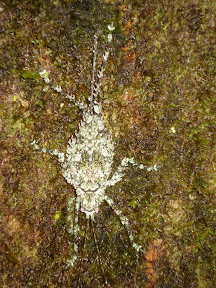 In a five hour bus ride, you can go from crisp mid-50s (Andean highlands) to muggy (the coast) or muggier (the rainforest) 85 degree weather. Over 1500 species of birds live here, drawing naturalists from all over. For instance, we met a woman in Mindo`s cloud forest doing a documentary on hummingbirds (colibrís) for PBS who told us how one drinks - not through suction (Aaron´s guess) but by unrolling its long tongue from its resting position, which is wrapped around the bird´s skull. We´ve seen more creepy crawlers of different sizes, colors and buzz-making abilities than Melissa would care to remember, and she was a bit startled by the hundreds of snails and crabs that slithered and scurried beneath our feet on the beach. All this in a country that`s roughly the size of Nevada.
Exotic as it is here, it´s not so much the creatures and landscapes that make us feel like foreigners as it is the culture, though it would be very wrong to suggest that there is only one culture. Indeed, the range of craftwork in Ecuador is awesome due to the range of indigenous groups that have managed to survive. Depending on what part of the country you are in, you might find hammocks woven from a single continuous piece of thread or jewelry made from seeds found in the rainforest or paintings on cornhusks using natural pigments. That said, it has been difficult to feel closer than arm´s length, closer than a spectator gawking at crafts, to locals that we meet.
Despite diligent study in a couple week-long language classes and extra-curricular attempts to increase our Spanish knowledge (particularly by Aaron), we remain far from fluent. And this language barrier coupled with what we`ve often heard described as a reserved nature among highlanders and aloof nature among coastal folks makes building relationships - in particular breaking through economic barriers - difficult. Aaron finds himself missing the sometimes overwhelming attention he received in Japan from curious locals eager to help. An Italian couple we met who own a (quite fabulous) restaraunt in the coastal fishing village of Puerto Lopez expressed similar sentiments - after 10 years, they have been unable to form any close friendships with native Ecuadorians.
The majority of the country`s indigenous and darker-skinned mestizos (people of mixed european and indigenous ancestry) appear to live in poverty. (According to our guidebook, 60 to 70% of Ecuador´s population lives below the poverty line.) In downtown Quito, shoeless five-year-olds roam the streets selling bubble gum with their mothers seemingly absent (though, as we soon observed, often inconspicuously waiting nearby). And in the midst of our hikes through the Andean countryside, virtually every child we saw asked for a gift of some sort - money or whatever else we had. Acts of kindness from adults were often abruptly followed by requests for money or patronage of their store, tour operation, etc. You can feel a bit like a slot machine, with people taking turns pulling your lever and hoping something will come out. Gringos are commonplace, and this ritual seems to be just a pragmatic part of life here.
We´ve been robbed twice, both times near Quito. The first time was on a bus to the nearby town of Otavalo. We thought keeping our bags at our feet was the safe way to go, but it wasn´t quite safe enough. Someone, we think a child, made a small slice in one of our bags, being very careful not to otherwise disturb it. Somewhat fortunately, all he got away with was several chargers and not the corresponding gear. And several weeks later Aaron was pick-pocketed in the midst of a New Year´s Eve crowd, losing a bit of cash.
This all makes it is easy to feel that your relationship with locals isn´t starting off on the right foot. When we do get past awkward beginnings, we often come up against one-word answers or the conversation somehow snakes its way back to suspciously economic territory. During our three-day stay in the rainforest with an indigenous community named Alukus, where we were already paying what on this trip is a large amount of money to live quite simply (to say the least), a number of our conversations with our guide emphasized how little he and his family have and ended in only slightly veiled requests for gifts in the future, purchases of his wife`s handcrafts, etc.
Even without conversation, some things are easily observed. We have noticed a refreshingly relaxed attitude in how locals interact with each other. While an unexpected bump on the subway in New York often results in rude looks or even a shouting match, an accidental elbow to the head practically goes unnoticed here. It takes a bit of getting used to the different notion of personal space, but it all seems part of a more "tranquilo," "que será será" attitude toward life.
On the coast, "tranquilo" doesn´t do the modus operandi justice. Melissa and I got very used to eating arroz mixto (rice and assorted seafood) and breaded fish because, well, that´s what every restaraunt sold (we were on hiatus from ceviche after some unfortunate stomach troubles). Forget about the enterprising attitude we`ve grown accustomed to where everyone`s trying to discover their own niche in the economic world, often the waitstaff/owners seemed mildly annoyed that a customer had just walked into their otherwise empty restaurant. Passion in this town was focused elsewhere, at least for the surfers. Watching them at sunset, when the waves got rowdy, was awesome. At least 20 of them would fill up a maybe a 40 meter stretch of breaks, making it look easy to share the waves while narrowly avoiding collision.
 While in Quito, we visited a provocative and inspiring collection of work by Oswaldo Guayasamín entitled Capilla del Hombre (Chapel of Man). The exhibition begins in a grand, airy room with massive paintings and murals hanging on the walls - quite different from the claustrophobic, tightly packed assortment of work we are accustomed to in museums and galleries. Each work (at left: La Ternura) depicts human suffering, in one way or another. But the paintings aren´t just heart wrenching, they´re beautiful, reminding us of other artforms that draw on pain to create beauty, such as the Blues. Kinship was a theme in much of the work, and Melissa was struck by the familial tenderness represented in the paintings - a reminder of how important support is to overcoming adversity. We couldn´t remember being this inspired by an artist since seeing Gaudí´s work in Barcelona a few years ago.
Perhaps the exhibition was all the more moving since we observed it after being struck by Ecuador´s poverty. There is a great quote written in large letters on the wall of the second floor that translates to: "I cried because I had no shoes until I saw a child with no feet."
This idea of being happy with (and grateful for) what you have has come up a lot during our stay here. It seems reflected in the anti-"rat race" culture, and is perhaps most succinctly captured in a saying related to us by a guide at another Guayasamín museum: "You are not rich if you have more but if you need less."
We recently encountered this same idea when we were invited to an "oración" with our homestay family in Cuenca. The small, weekly family gathering involves prayer, giving thanks, seeking forgiveness, and reading and discussing scripture. That night, the chosen scripture led to a discussion of questioning one´s needs and taking the time to appreciate what you have now instead of ceaselessly striving to acquire more. (Once before, we observed a similar sort of gathering. We think it´s a worthwhile tradition, and one that does not necessarily need to be linked to religion.)
Yesterday was our last day with our Cuenca family. While we were there we were treated to the inside scoop on sights and events - a fútbol game between top university teams from Ecuador and Argentina, a trip to an orchideário that breeds over 1500 species, and an annual concert of four traditional South American groups. But, best was the opportunity to use our Spanish and befriend people in a country where we obviously have not had the easiest time getting to know locals. Among other things, our family educated us on Latin American music and rhythms. On our final evening, while we and our homestay parents sipped homemade canelazo, they treated us to quite a medley of live traditional songs complete with guitar acompaniment.
The family´s lifestyle, compared to others that we have mentioned in this post, was not that different from our own. Seemingly not unrelated is the fact that they look European, although they consider themselves mestizo. We have learned that mestizo is a category as broad, if not broader, than "black" in the United States.
It was instructive to get their take on racial prejudice in South America. In some ways it seems like race relations here are similar to those in the United States 50 years ago - advertisements and television programs only display white faces, it`s relatively unheard of to come across a mixed race couple and there are few, if any, indigenous or Afro-Ecuadorean people in positions of power. And while it has been reassuring to hear our host family and others voice their awareness of and disagreement with the racist attitudes here, it is disheartening to learn that they believe progress in addressing them is slow.
As you can hopefully see from our pictures (and there are more to come), Ecuador is a mind-blowingly rich and diverse nation. The high and low points, and the experiences that have made us feel most foreign, have broadened our perspectives and at times reminded us of how much wealth and comfort we have access to in the United States.
Bye for now...
xoM+A

2 comments:
What an interesting piece. I know very little about that region so this is all so new to me. Maybe you two should become traveling journalists? I hope you find some more friendly locals!
WOW. It seems like on a trip where you were not %100 sure what you were "looking for" you two have received so much. Just in the tone of your newest blog and the details I can tell this trip will effect the rest of your lives in so many ways; how you raise your children and definitely your interests. I cant wait for you to get back and rub some the humility off on me.
Love you both.
Post a Comment